

В европейской части России затмение также можно будет наблюдать. В Москве Луна закроет Солнце приблизительно в 12:50. Пик придется на 13:40 минут по московскому времени. К 14:30 затмение закончится. Необходимо отметить, что в Москве Луна закроет диск Солнца всего на 18%.
http://www.newsru.co...05/suntime.html

Сейчас солнечное затмение будет!
Started By
Ste!
, Oct 03 2005 8:37 AM
14 replies to this topic



#5
 Posted 03 October 2005 - 13:23 PM
Рыжая
-

- Свои
- 1537 posts
- Дария Конурбаева
а мы в это время на физике контрольную писали... ОбЫдно... =/
Невозможное возможно.
#6
Posted 03 October 2005 - 13:26 PM
Timon
-

- Свои
- 368 posts
- Артём Ардаширов
я даж не обратил внимание, хотя всегда смотрю в окно!!
#7
Posted 03 October 2005 - 13:28 PM
Ste!
-

- Свои
- 15192 posts
[везде]сущий выдумщик!
- Степан Чижов
Если бы ты просто смотрел в окно, то и не заметил бы. Всего 18% было затмение. Без затемнения не увидеть.
#8
Posted 03 October 2005 - 13:39 PM
Timon
-
- Свои
- 368 posts
- Артём Ардаширов
жалко! ЛЮБЛЮ ВСЯКИЕ ТАКИЕ ШТУЧКИ!!
#9
Posted 03 October 2005 - 15:38 PM
А чего тогда на самую дальнюю парту от окна садишься?я даж не обратил внимание, хотя всегда смотрю в окно!!


#10
Posted 03 October 2005 - 15:55 PM
KiberGus
-
- Genius loci
- 6561 posts
- Алексей Гусейнов
А я про дискетку не догадался бы. Жаль что не знал, чтооно будет.
Зато, обладая единственной в мире подводной орбитальной группировкой спутников глонасс...

#11
Posted 03 October 2005 - 16:07 PM
А я забыл,тут дочка позвонила,мол затмение начинается.В руках с музыкальнымА я про дискетку не догадался бы. Жаль что не знал, что оно будет.
диском бегом на балкон и через диск смотрел.Здорово! Все равно как через закопченое стекло .asart.
#12
Posted 03 October 2005 - 17:57 PM
вау, красиво как! а я даже не знала об этом =(((
#13
Posted 03 October 2005 - 18:47 PM
Да, действительно как-то не было широко распространено о затмении. А жаль.
#14
Posted 04 October 2005 - 14:36 PM
Угу. Я в инете про это прочитал, уже когда всё закончилось...Да, действительно как-то не было широко распространено о затмении. А жаль.
#15
Posted 05 October 2005 - 8:13 AM
Ste!
-
- Свои
- 15192 posts
[везде]сущий выдумщик!
- Степан Чижов
Вот как это выглядело в Испании:
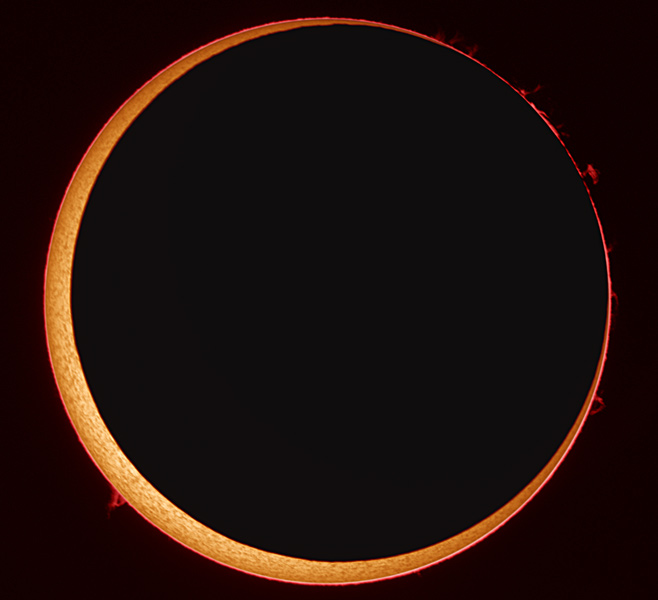
Annular Solar Eclipse at High Resolution
Credit & Copyright: Stefan Seip
Explanation: On Monday, part of the Sun went missing. The missing piece was no cause for concern -- the Moon was only momentarily in the way. The event was not a total eclipse of the Sun for any Earth-bound sky enthusiast but rather, at best, an annular eclipse, where the Moon blocked most of the Sun. Because of the relatively large distance to the Moon during this Earth-Moon-Sun alignment, the Moon did not have a large enough angular size to block the entire Sun. Those who witnessed the solar eclipse from a narrow path through Spain and Africa, however, were lucky enough to see the coveted Ring of Fire, a dark Moon completely surrounded by the brilliant light of the distant Sun. Pictured above is a Ring of Fire captured two days ago in unusually high resolution above Spain. The resulting image shows details of the granular solar surface as well as many prominences around the Sun.
http://www.livejourn...0439.html?nc=11
Annular Solar Eclipse at High Resolution
Credit & Copyright: Stefan Seip
Explanation: On Monday, part of the Sun went missing. The missing piece was no cause for concern -- the Moon was only momentarily in the way. The event was not a total eclipse of the Sun for any Earth-bound sky enthusiast but rather, at best, an annular eclipse, where the Moon blocked most of the Sun. Because of the relatively large distance to the Moon during this Earth-Moon-Sun alignment, the Moon did not have a large enough angular size to block the entire Sun. Those who witnessed the solar eclipse from a narrow path through Spain and Africa, however, were lucky enough to see the coveted Ring of Fire, a dark Moon completely surrounded by the brilliant light of the distant Sun. Pictured above is a Ring of Fire captured two days ago in unusually high resolution above Spain. The resulting image shows details of the granular solar surface as well as many prominences around the Sun.
http://www.livejourn...0439.html?nc=11


2 user(s) are reading this topic
0 members, 2 guests, 0 anonymous users

